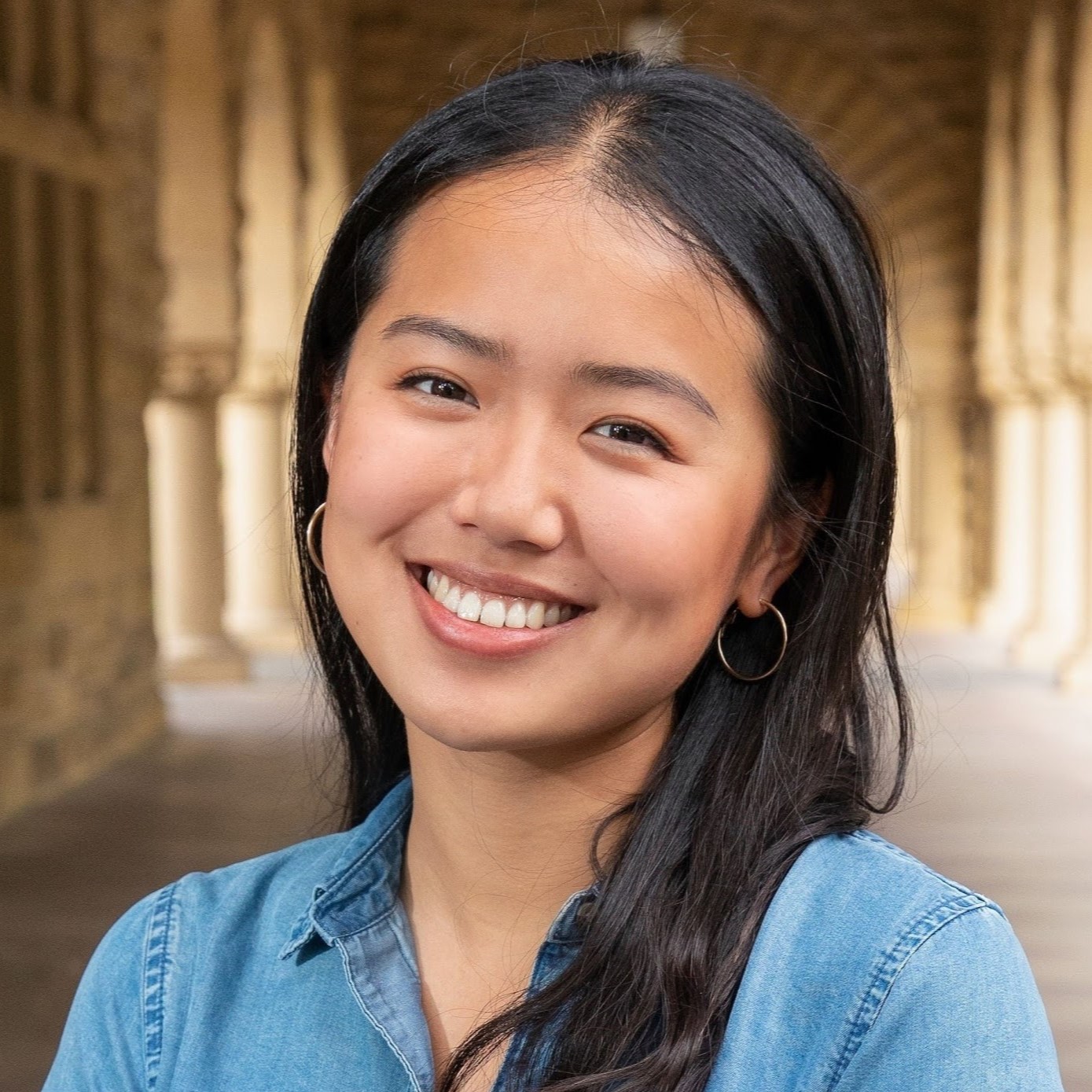
Hello! I’m Irena, a CS PhD at Stanford University, advised by Carlos Guestrin and supported in part by the Crosby Intelligence Fellowship.
My research interests center on human-AI collaboration. This has included studying:
- User modeling: designing literature-grounded user models to evaluate personal agents (CoShop)
- Oversight: building tools that help users monitor and understand failure modes in AI systems (AdaVision, Model Equality Testing)
I’ve also previously worked on multimodal pretraining with OpenFlamingo and distributional robustness with WILDS.
Before my PhD, I received my BS/MS from Stanford, working with Pang Wei Koh and Percy Liang. I also interned at Microsoft Research with Marco Tulio Ribeiro.
Note: I’ve published under both “Irena Saracay” and “Irena Gao” (my maiden name).
News
- Oct 2026: New project Readable Intelligence is live! We’re making AI-generated math papers easier to read through clarity-focused rewrites and tools for understanding the argument. (tweet)
- Jul 2026: CoShop was accepted to COLM 2026.
Selected publications
* denotes equal contribution.
-
Beyond expert users: agents should help users construct preferences, not just elicit themIn Conference on Language Modeling 2026.
Users often can’t state a preference about a feature until they understand it, so the right elicitation message (a question, an explanation, an example) depends on how familiar the user is with that feature. We build a simulated user grounded in information economics and use it to benchmark shopping agents, finding that frontier agents fail to adapt how they probe a user to the user’s domain familiarity, even with access to the user’s history.
-
Model equality testing: which model is this API serving?In International Conference on Learning Representations 2025.
Users accessing LLMs through APIs can’t easily verify which model they’re getting. We frame this as a two-sample testing problem and develop a test that detects quantization, watermarking, and fine-tuning from about 10 samples per prompt. Auditing 31 commercial Llama endpoints, we find 11 serve different distributions than Meta’s released weights.
-
OpenFlamingo: an open-source framework for training large autoregressive vision-language models2023.
An open-source replication of DeepMind’s Flamingo models: a family of 3B–9B vision-language models pretrained on interleaved image-text data, reaching 80–89% of Flamingo’s performance across seven benchmarks.
-
Adaptive testing of computer vision modelsIn International Conference on Computer Vision 2023. (Oral Presentation)
People are good at judging whether a model’s behavior is a bug, but not at knowing where to look. We build an interactive tool that pairs the two: foundation models propose failure modes and retrieve examples, and users label and refine them. In user studies, people found failure groups with 2–3x higher error rates than automatic error clustering.